
Moving Lens Effect
A secondary CMB anisotropy induced by the transverse motion of gravitational potentials.
First detection at $4.8\sigma$ ($b_{\rm ML} = 1.24 \pm 0.26$), from ACT DR6 × DESI Legacy Imaging Surveys (LRGs).
What is the moving lens effect?
Gravitational potentials which change in time induce fluctuations in the observed cosmic microwave background (CMB) temperature. Cosmological structure moving transverse to our line of sight provides a specific example known as the moving lens effect — a secondary CMB anisotropy induced by the transverse motion of gravitational potentials.
The bulk motion of cosmological structure induces a small-scale dipolar temperature anisotropy of the CMB, centered around halos and oriented along the transverse velocity field. The observed CMB temperature fluctuations combined with the observed matter over-density can be used to infer the transverse velocity of cosmological structure on large scales.
Velocity fields can be reconstructed at cosmological scales from their influence on the correlation between the CMB and large-scale structure. The kinetic Sunyaev-Zel’dovich (kSZ) effect and the moving-lens effect will both be measured to high precision with upcoming cosmology experiments; the large-scale transverse-velocity field, reconstructed from measurements of the moving-lens effect, can be used to measure $f\sigma_8$ to high precision.
The detection
In Hotinli et al. (2605.18938), we report the first detection of the moving lens effect, using Atacama Cosmology Telescope (ACT) DR6 CMB temperature maps and luminous red galaxies from the DESI Legacy Imaging Surveys.
We find strong evidence for a non-zero amplitude of the cross-correlation $b_{\rm ML} = 1.24 \pm 0.26$ ($4.8\sigma$), consistent with the halo-model prediction for the moving lens signal.
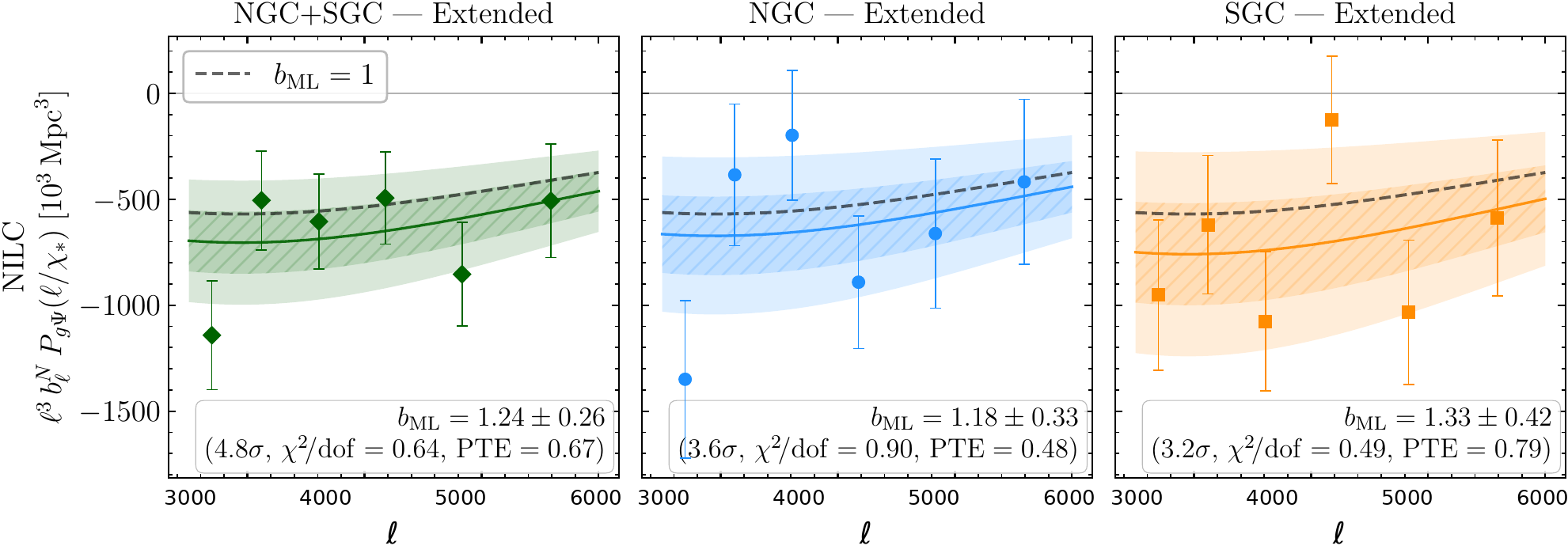
Measured galaxy-velocity cross-correlation in three sky cuts (NGC+SGC, NGC, SGC), from NILC foreground-cleaned ACT DR6 maps. The headline detection is $b_{\rm ML} = 1.24 \pm 0.26$ ($4.8\sigma$, $\chi^2/{\rm dof} = 0.64$, PTE $= 0.67$) in the NGC+SGC analysis (left panel). The dashed curve shows the halo-model prediction for $b_{\rm ML} = 1$. From Hotinli et al. (2605.18938).
These results constitute the first detection of the moving lens effect and unlock access to transverse velocities.
Lineage
From prediction to first detection — eight years.
Prediction
Hotinli, Meyers, Dalal, Jaffe, Johnson, Mertens, Münchmeyer, Smith & van Engelen (1812.03167) Explored how the observed CMB temperature fluctuations combined with the observed matter over-density can be used to infer the transverse velocity of cosmological structure on large scales, and showed that near-future CMB and galaxy surveys will have the statistical power to make a first detection of the moving lens effect.
Forecasts and applications
Hotinli, Johnson & Meyers (2006.03060) Introduced a set of optimal filters for the small-scale dipolar temperature anisotropy centered around halos and oriented along the transverse velocity field, and forecast that a high significance detection can be made with upcoming experiments.
Hotinli, Smith, Madhavacheril & Kamionkowski (2108.02207) Showed how the large-scale transverse-velocity field, reconstructed from measurements of the moving-lens effect, can be used to measure $f\sigma_8$ to high precision.
Simulation-based analyses
Cayuso, Bloch, Hotinli, Johnson & McCarthy (2111.11526) Created a simulation framework for generating realizations of properly correlated CMB maps and redshift-binned galaxy number counts, and used it to validate a velocity reconstruction pipeline and assess map-based systematics such as masking.
Hotinli, Pierpaoli, Ferraro & Smith (2305.15462) Demonstrated, from simulated cosmological maps of the thermal Sunyaev-Zel'dovich effect and the cosmic infrared background, that oriented stacked profiles of these foregrounds show significant gradients aligned with the transverse velocity of halos — a new signal that also constitutes a challenge for the detection of the transverse velocity through the moving lens effect for stacked halos.
Hotinli & Pierpaoli (2401.12280) Investigated two strategies for the detection of the moving lens signal — pairwise transverse-velocity estimation and oriented stacking — using realistic simulations of competing signals and foregrounds, and confirmed that the moving lens effect can be detected at $\ge 10\sigma$ level by a combination of CMB-S4 and LSST surveys.
Detection
Hotinli, Smith, Ferraro, Beheshti, Kosowsky, Pierpaoli & Schaan (2605.18938) First detection of the moving lens effect, $b_{\rm ML} = 1.24 \pm 0.26$ at $4.8\sigma$, from ACT DR6 CMB temperature maps and luminous red galaxies from the DESI Legacy Imaging Surveys.
Resources
- arXiv:2605.18938 — First detection of the moving lens effect with ACT and DESI LS (2026)
- arXiv:2401.12280 — On the Detectability of the Moving Lens Signal in CMB Experiments (2024)
- arXiv:2305.15462 — Transverse velocities and matter gradient correlations: a new signal and a new challenge to moving-lens analyses (2023)
- arXiv:2111.11526 — Velocity reconstruction with the cosmic microwave background and galaxy surveys (2021)
- arXiv:2108.02207 — Cosmology with the moving lens effect (2021)
- arXiv:2006.03060 — Optimal filters for the moving lens effect (2020)
- arXiv:1812.03167 — Transverse Velocities with the Moving Lens Effect (2018)